A rising tide lifts all boats. When tribal nations do well, everyone does well. This webcast series from the Harvard Project on Indigenous Governance and Development showcases stories of excellence in tribal self-governance, drawing from the Honoring Nations family of awardees and decades of Harvard Project research. With this series, our vision is to amplify Indigenous-driven solutions that strengthen sovereignty, inspire innovation, and advance community well-being, demonstrating how the exercise of strong tribal governance benefits all. In this episode, the Landback team from the Harvard Project on Indigenous Governance and Development discusses their research around Indigenous conservation practices. According to their findings, Indigenous peoples are achieving equal or superior conservation outcomes across the globe, and supporting Indigenous-led stewardship is a key strategy to combat biodiversity loss and climate change.
Speaker Bios:
Dr. Miriam Jorgensen is a Research Scientist at the University of Arizona Udall Center for Studies in Public Policy and holds the additional titles of Research Director of the University of Arizona Native Nations Institute and Research Director of the Harvard Project on American Indian Economic Development.
Dr. Laura Taylor is a Faculty Lecturer at the University of Miami Rosenstiel School of Marine, Atmospheric and Earth Science, a Postdoctoral Fellow with the National Bureau of Economic Research, and a Research Fellow with the Harvard Project on Indigenous Governance and Development.
Colette Anton is the Communications Coordinator for the Harvard Ash Center for Democratic Governance and Innovation.
For additional readings on the topics presented today, check out these resources:
• The Harvard Project on Indigenous Governance and Development: https://indigenousgov.hks.harvard.edu/
• “Experts, not Obstacles: Indigenous Conservation Excellence and the Trap of Conservation at any Cost” - https://ash.harvard.edu/resources/exp...
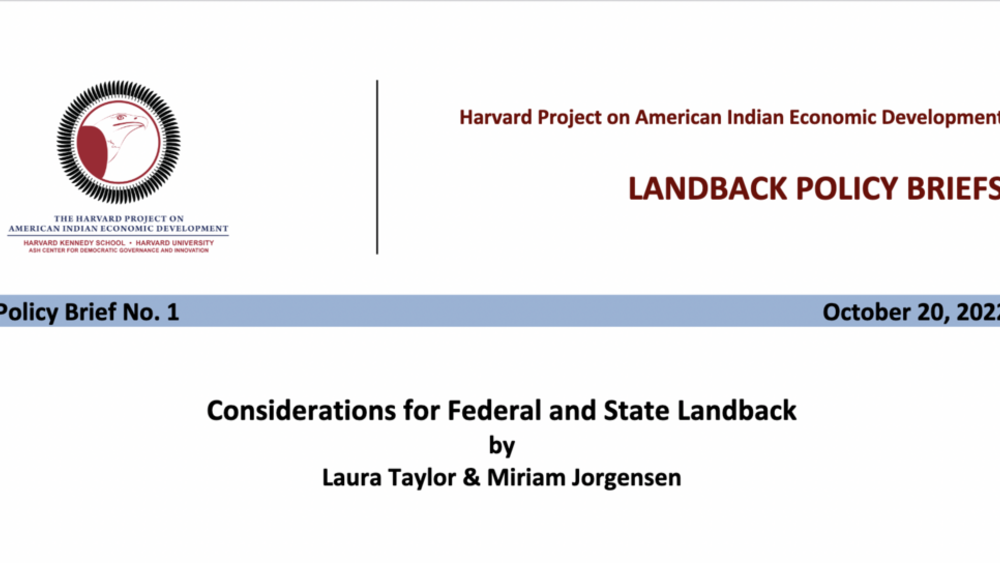
• “Considerations for Federal and State Landback” - https://ash.harvard.edu/resources/con...
Transcript
Transcripts for all videos are available by request. Please email us: nni@arizona.edu.