
Indigenous Governance Database
Leadership
British Columbia Assembly of First Nations Governance Toolkit: A Guide to Nation Building
The BCAFN is pleased to present the first edition of the BCAFN Governance Toolkit: A Guide to Nation Building in accordance with our Building on OUR Success action plan and the first pillar of that plan, "Strong and Appropriate Governance." The Toolkit is a comprehensive guide intended to assist…
Huu-ay-aht First Nations Government Act
The Government Act sets out the legal framework for the Huu-ay-aht government which includes the following branches: the Legislature, Executive Council, the Ha’wiih Council, and the People’s Assembly.
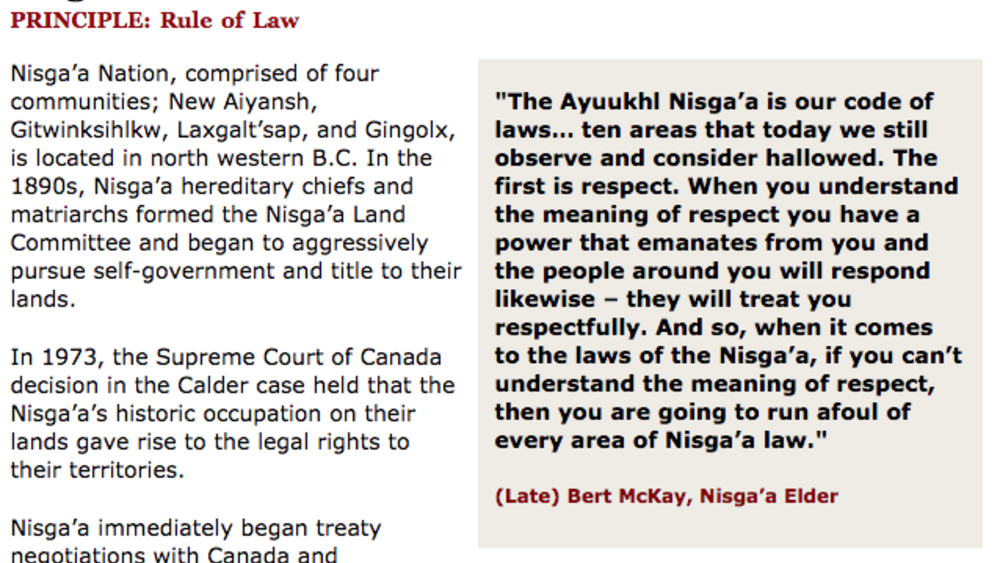
Best Practices Case Study (Rule of Law): Nisga'a Nation
Nisga'a Nation, comprised of four communities; New Aiyansh, Gitwinksihlkw, Laxgalt'sap, and Gingolx, is located in northwestern B.C. In the 1890s, Nisga'a hereditary chiefs and matriarchs formed the Nisga'a Land Committee and began to aggressively pursue self-government and title to their lands.…
Indigenous Leadership in a Flat World
The world is flat, so we are now told. In his recent book The World is Flat: A Brief History of the Twenty-First Century, Thomas Friedman argues that since the beginning of the Twentieth century globalization has evolved at an astronomically fast rate. As a result, the world is now…
Legal Pluralism and Tribal Constitutions
What do pigs roaming the streets of New York City during the first half of the nineteenth century and tribal constitutions have in common? The most obvious (and often the most correct) answer is, undoubtedly, “absolutely nothing.” However, tribal advocates, particularly those concerned with the…
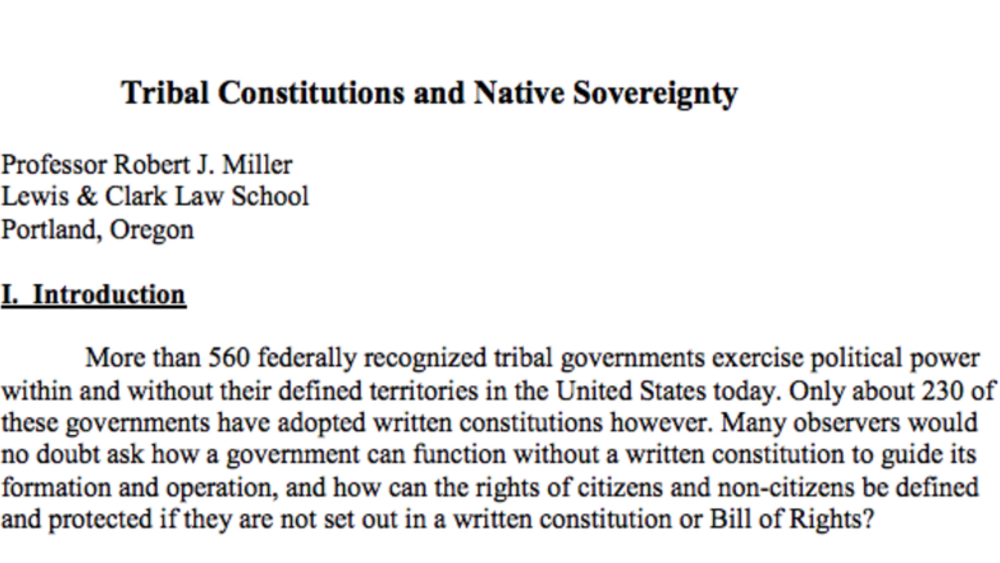
Tribal Constitutions and Native Sovereignty
More than 565 Indigenous tribal governments exercise extensive sovereign and political powers within the United States today. Only about 230 of the native communities that created these governments, however, have chosen to adopt written constitutions to define and control the political powers of…